How to Calculate Backlog for an Engineering or Architecture Firm
Backlog is the signed fee you have not billed yet. Divide it by a normal month of billing and you get months of work ahead. Six to twelve months is the range buyers call healthy.

Zeus Lopes
Forward Deployed Engineer, Excede
Zeus builds the Excede platform, delivers it with each firm, and audits the numbers until they match how the firm actually runs.
Backlog is the signed fee you have not billed yet. Divide that amount by what the firm bills in a normal month and you get months of work ahead. Buyers of architecture and engineering firms call six to twelve months a healthy range. The number most firms staff against is larger than the work they will actually bill.
I'm a Forward Deployed Engineer at Excede. I sit with a firm's real data and work out what each number means. With backlog, the subtraction is easy. What you include, and what you then staff against, is where the number goes wrong.
The formula
Backlog = Signed contract value − Amount already billed
Months of coverage = Backlog ÷ Average monthly net revenue
Signed means a contract, a notice to proceed, or an approved change. A proposal is pipeline. It is not backlog until someone signs it.
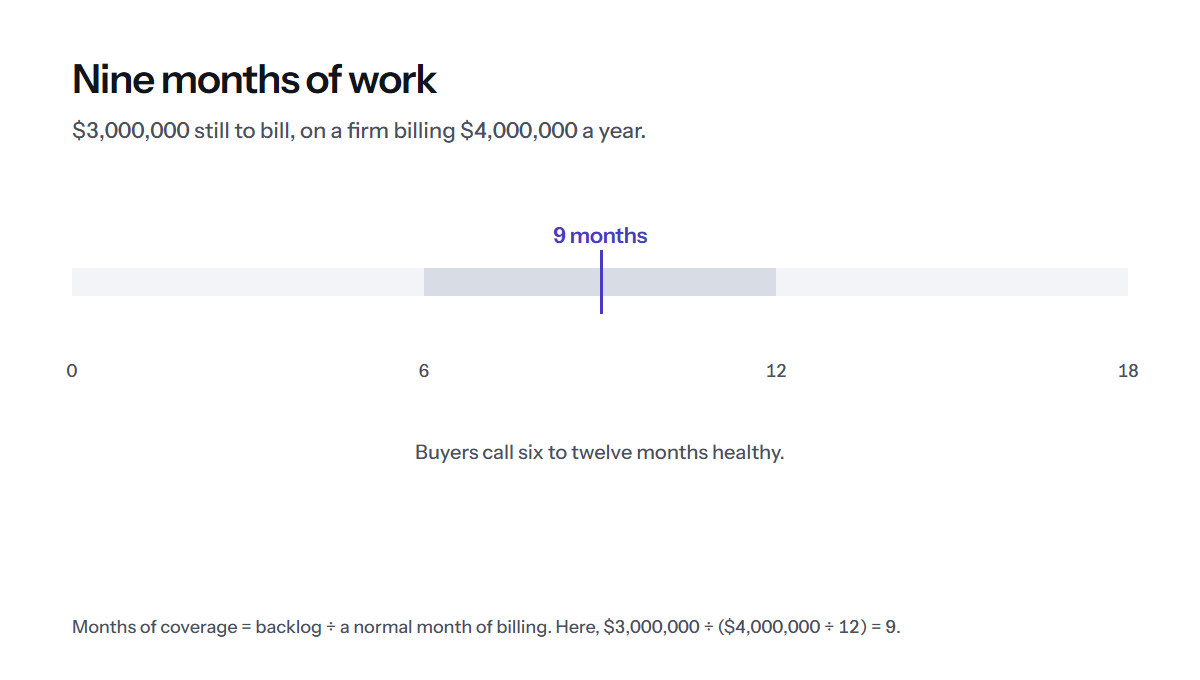
Allen Business Advisors, who advise firms through sales, use the same formula and give the example everyone repeats. A firm billing $4,000,000 a year with $3,000,000 still to bill is carrying nine months of work. They call six to twelve months a healthy position for a firm heading into a sale.
Wipfli publishes a different target: backlog at least equal to a year of operating costs. That is a useful test, and it is not nine months of revenue. A firm with a profit margin near 20% spends about 80 cents of each revenue dollar on costs, so a year of costs is closer to ten months of billing. Pick one ruler and write it on the report.
The denominator is the argument
Months of coverage move when you change what "a normal month" means.
Deltek Ajera divides backlog by the average of the last three months of billings. A big invoice in March makes April look like less work than the firm has. Allen's example divides by a full year of billing, which hides a slow quarter. Excede divides what is still to bill by the last six months of net service revenue, so one fat invoice and one empty month both get diluted.
None of these is a wrong formula. They answer "how long does the signed work last" with three different clocks. Compare your firm with itself on one clock.
Still to bill, and still to do
Two calculations share this name.
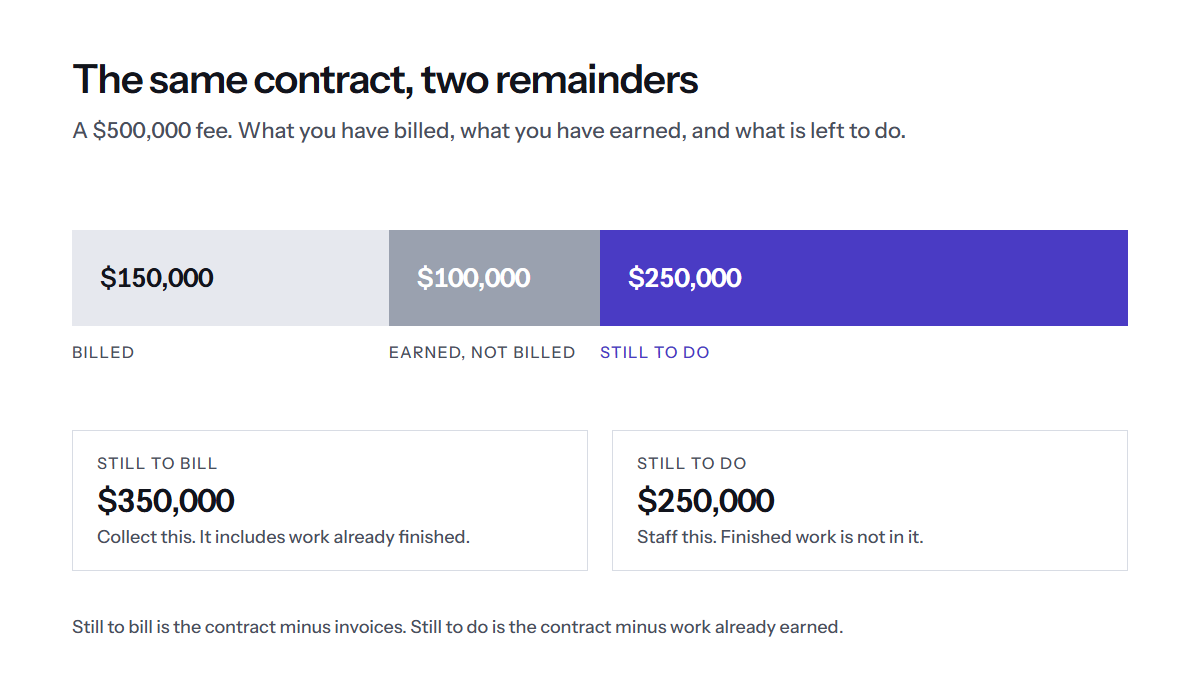
Still to bill is the contract minus invoices. Work the team has already finished, and not invoiced, is still in the number. That is the right number for cash. It is the number a buyer asks for, and it is the number in the Allen example.
Still to do is the contract minus the work already earned. Finished work you have not invoiced drops out. Base Builders calculates backlog this way, fee minus earned value, and keeps the earned-but-not-billed gap in a separate number, WIP.
Staff the second number. Collect the first. A report that only shows still to bill will tell you to keep people on work they have already finished.
Take a $500,000 fee. $150,000 is billed. Another $100,000 is earned and sitting uninvoiced. The work still to do is $250,000. Still to bill is $350,000, because it includes the finished $100,000. Staff the $250,000.
Leave the pass-through out if you are staffing your own people
A $400,000 mechanical contract with $80,000 of commissioning subconsultant in it does not contain $400,000 of your firm's work. The same trap shows up in net multiplier: leave the pass-through in and the project looks bigger than the labor you will spend.
If the question is "what contracts do we hold," gross backlog, subs included, is the honest list. If the question is "do we need another engineer," take the subs out first.
Where the hire goes wrong
The names here are made up. The pattern is not.
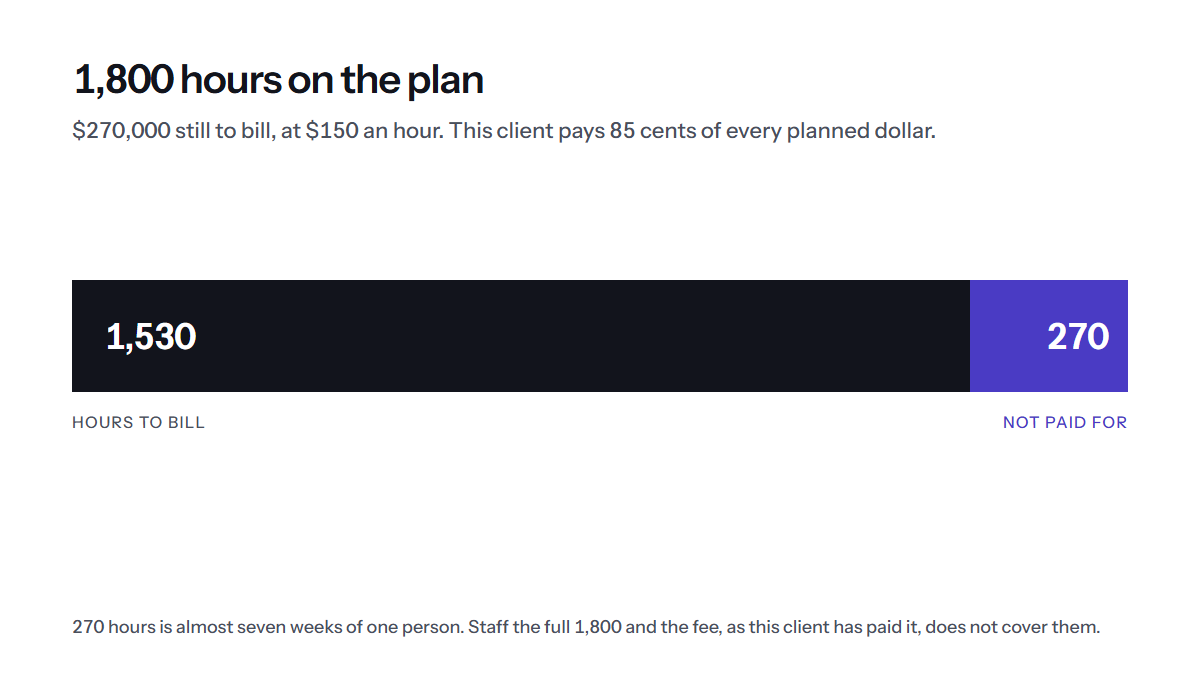
A mechanical firm has $270,000 still to bill on a school renovation. At $150 an hour, that is 1,800 hours. The project manager puts those hours on the plan and starts looking at who is free next quarter.
On this client, the firm has been billing 85 cents of every dollar it planned. That history is realization, pointed forward. Apply it before you staff:
| Hours | |
|---|---|
| Remaining fee, at $150 an hour | 1,800 planned |
| What this client has actually been paying | 85% |
| Hours you should expect to bill | 1,530 |
| Hours in the plan that this client has not been paying for | 270 |
270 hours is almost seven weeks of one person. Staff the full 1,800 and you are carrying someone the fee, as this client has actually paid it, does not cover.
The firm-level version is the same subtraction. Eight months of still-to-bill feels like room to hire. Take out the work already done, then take out the share this kind of project never bills, and the spare months shrink. The signed contract did not change. The amount of it you should hire against did.
How Excede counts it
The backlog figure on Firm Health is fees on open projects minus what has already been billed, divided by the last six months of net service revenue. Under six months of coverage we treat as thin.
The year-end forecast asks a second question. Face value keeps every remaining month at the amount in the projection, which is right when those amounts are contracted fees moving between months. Measured scales each project by how much of its plan it has actually billed. A project that bills what it planned stays whole. A project that slips gets a smaller number, and that smaller number is the one to staff.
How to check your own number
- List signed contracts and approved changes. Leave proposals off the list.
- Subtract what you have billed. That is still to bill. Divide by one average month, and write down which average you used.
- Subtract work already earned and not invoiced. What remains is still to do. That is the staffing number.
- Multiply still to do by the share of planned fees this kind of work has actually billed. The gap between that result and the report is the hire the fee will not pay for.